What pump-fill with kettles actually means, why it starts with the kettle, and how the right pump technology keeps your product safety and quality high.
What is food pumping, and when does it matter?
Genier kettles can be emptied fastest through tilting, which happens at a comfortable working height of 600 mm. That is the default choice for most situations. Fast, straightforward, and no additional equipment needed.
But when the process requires portion accuracy — filling individual bags, trays, or bottles at volumes between 500 ml and 4.5 litres — that is where a pump-fill station adds a precise, controlled layer on top.
This applies to both hot-fill production and cook & chill operations. In chilled production, viscosity increases significantly as temperature drops. The pump needs to handle both.
It starts in the kettle
The pump's performance depends on what the kettle has produced.
A Genier mixing kettle controls temperature and consistency throughout cooking — variable mixer speeds, temperature precision to within one degree. The result: a batch where viscosity, structure, and temperature are uniform from the first litre to the last.
A product that is thicker at the bottom than the top, or that has cooled unevenly, will behave inconsistently in any pump. Portion weights drift. For kitchens producing premium soups, meat sauces, or prepared meals, consistent kettle output also protects end product quality. Chunks that arrive intact and sauces that remain clear are part of what the customer expects.
The Genier kettle and Regethermic Pump-Fill Station connect directly via a 2.5" discharge pipe. No intermediate containers, no manual transfers, no open-air exposure between cooking and portioning.
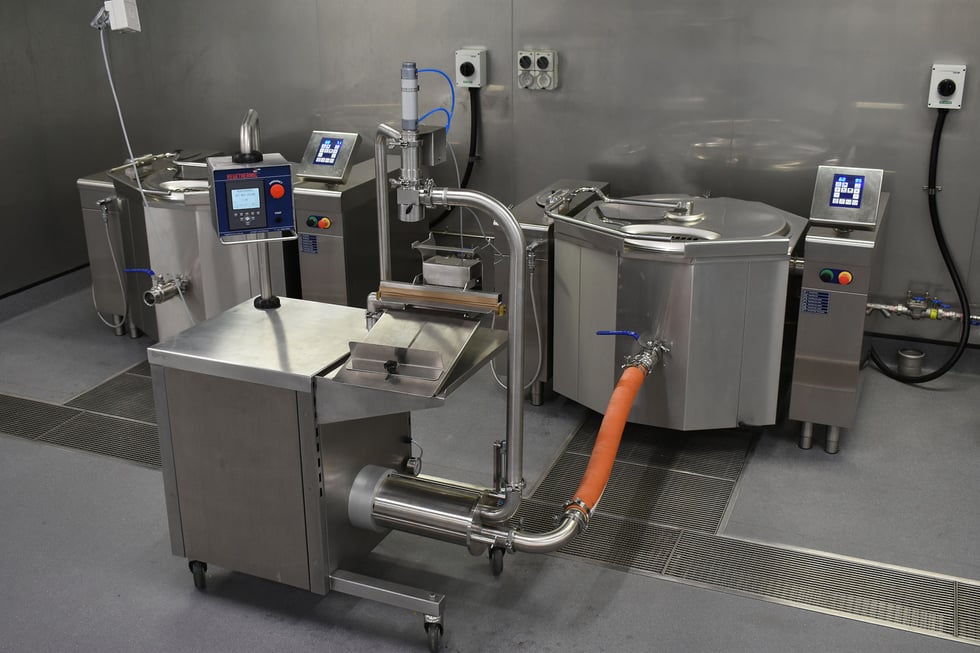
Maximizing Particle Integrity: The Impact of Pipe Diameter
The connection runs through a 63 mm (2.5") pipe, when many systems use smaller pipe size, 2.0" (50 mm). The difference matters in practice:
- Larger diameter = less flow resistance for thick, viscous products
- Chunks move freely: a 30 mm piece of braised meat or root vegetable passes without being forced through a narrower channel
- Less pressure needed, which means gentler handling throughout
Products compressed and damaged in a 50 mm line arrive intact through a 63 mm line. Pipe diameter is the first factor in gentle pumping.
Comparing Pump Types: Which one fits your workflow?
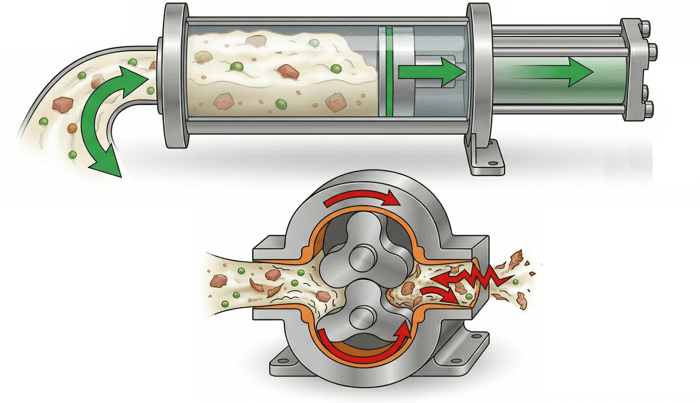
Rotary lobe pumps handle thin, consistent liquids well.
With thicker products:
- Higher viscosity requires faster rotation to generate suction
- Faster rotation increases shear force. Chunks get damaged, sauces lose structure
- At high viscosity, the pump can cavitate, pulling air instead of product and disrupting portion accuracy
Piston pumps, like the Regethermic, work differently. A pneumatic piston draws product into the cylinder by vacuum, then pushes it out through large-bore valves. No rotating parts contact the food. Linear, controlled, and gentle regardless of viscosity.
Ball valve or butterfly valve
- Ball valves: for products with particulates. The large spherical opening allows whole pieces of meat or vegetables to pass without contact with the valve mechanism.
- Flap valves: for smooth, high-viscosity masses where flow direction control is the priority.
At 63 mm, both pipe and valve geometry allow chunk transfer without mechanical stress. Piston pumps also dose by volume – 500 ml to 4.5 litres – consistently regardless of viscosity variation. No separate weighing scale needed.
Cleaning: hygiene you can verify
Pump systems that rely on circulating cleaning water through a closed interior cannot be visually confirmed clean. Warm, moist interiors between batches create conditions where microbial growth becomes a risk.
The Regethermic disassembles differently:
- Full product contact path — piston, cylinder, valves — apart by hand in under 3 minutes, no tools
- Parts go into a standard dishwasher
- Every surface visually checked during reassembly
- Parts dry separately, eliminating residual moisture
The pump can be cleaned and ready again while the kettle is already into the next cook cycle. In a kitchen running multiple batches per shift, that recovered time is real production capacity.
The full process from kettle to portion
- Genier kettle completes a batch with consistent texture, precise temperature throughout
- Pump connects directly to the 2.5" kettle discharge
- Filling begins: set volume, hand trigger or foot pedal, both hands free
- HACCP data, like temperature, volume, bag coun,t logs automatically to USB
- Pump disassembles in 3 minutes, parts to dishwasher
- Kettle starts next batch. Pump reassembled and ready before cooking is done.
If your kitchen runs high-viscosity products where portion consistency is a production requirement, the Regethermic Pump-Fill Station is built for exactly that. See the full specification at Genier.com.